Saturday, 17 March 2012

Childhood Favourites: You've told me yours...

Inspired (as I hoped I would be) by all the many contributions I received in regards to my previous entry on Childhood Favourites, I think I've finally managed to cobble together a list of some of my old favourites from my younger years. I'll tell you what though, it wasn't easy; at one point, said list was about two dozen books long, and it took a fair bit of ruthless trimming to get it down to the more manageable selection below. I would like to take a few moments, though, to remember the few that didn't quite make the list...
  • The Animal Ark series, by Ben M. Baglio under his alias, Lucy Daniels. As a child, I was convinced I wanted to be a vet when I grew up, and this series of books about a girl who's parents are both vets, and who manages to rescue dozens of animals, was right up my street. 
  • The Twins At St. Clare's, by Enid Blyton. Much in the same vein of Mallory Towers, this was the first book in a series about two Irish twins and their escapades at their boarding school. It was jolly ripping to read and excellent fun, what with the circus and the midnight feast and all. Spiffing!
  • Danny, The Champion Of The World, by Roald Dahl. Like most people who mentioned Dahl, I found it really hard to pick just one, but eventually I succeeded. This was a close second, what with all the drugged pheasants, trout-tickling doctors and general espionage.
 Valiant though these books are, they aren't quite so close to my heart as my (current) selection, but I still felt they deserved a mention at the very least. I've also not included Vampire Park by Willis Hall, or Winnie The Witch by Valerie Thomas and Korky Paul, as they were both mentioned in my previous entry on the subject, and I felt it was time to make room for a few more. It also freed up two more spaces, so I'm being economical.

So we've had the starters - onto the main event!


George's Marvellous Medicine, by Roald Dahl
  This was a genuinely tough choice, as I've recently had the pleasure of being able to re-read most of Roald Dahl's books. My parents bought one of my cousins a boxset of all the most popular Roald Dahl books - about 15 in all - for a Christmas present one year, and I was so insanely jealous that I spent a good half an hour organising the books in the order I thought my poor cousin should read them. Apparently the hints I dropped later in the car were heard, because the next year, I got the same boxset all to myself, and I've worked my way through it more than once. Now, when I asked all my Facebook and Twitter chums what their favourite books from childhood were, Roald Dahl cropped up more than once, though mostly as a general choice. I challenged myself to pick one, and it was hard; there was The Giraffe, The Pelly And Me, about a young boy who opens a sweet shop with a giraffe, a pelican and a monkey; the aforementioned Danny, The Champion Of The World, and of course, a girl after my own heart, the book-gobbling Matilda. But in the end, I knew it had to be George's Marvellous Medicine. Why? Because it's the only book I ever tried to copy. I used to lock myself in the bathroom, fill the sink half up with water, and then add bits of everything I could find in the bathroom - soap, shampoo, face cleanser, toothpaste, sun cream and aftersun, all mixed together with the end of my sister's toothbrush, and topped off with a squirt of my dad's shaving foam to give it that 'mediciney' look. I'd do the same in the summer months, except with a bucket of water, and bits of all the plants in the garden, with soil to thicken it up. I never dared drink either mixtures, of course - even I knew that such concoctions were more likely to send me to A&E than sixty feet up in the air - but it was excellent fun, especially the bathroom medicine, which always went a cool shade of turquoise thanks to the toothpaste and mouthwash. Roald Dahl never forgot what it was like to be a child; he knew how they thought, and he certainly had the measure of kids like I was when he wrote this.

A Little Princess, by Frances Hodgson Burnett
 I was a tomboy when I was young - I fractured my arm playing football, got in trouble for taking off my Holy Communion dress to climb a tree before anyone got to take a photo, and had to be helped out of a conifer by a neighbour on a ladder after I climbed up too high and couldn't get back down (protestations that I knew what I was doing, and was taking my time, were not believed). But, like so many little girls, I loved the idea of being a princess, and this story - a riches-to-rags-back-to-riches tale of a young girl at a boarding school - captured my heart. I actually read a 'modern' re-write first, which I don't remember a lot about, apart from the main character was American and got her computer taken away - but that first taste was outclassed by the original tale. It's not just the fairytale-like qualities that I loved; it was the overcoming of obstacles by Sara, the main character, and the strength of her mind, her kindness and her belief in happy endings that attracted me. Sometimes now I do read it and Sara does seem a little bit too perfect - her one 'weakness' is a slight temper, which is revealed once in an altercation with an older pupil at her school - but the feeling the story gives me remains the same; a sheer childlike delight at the 'Magic' that Ram Dass works, her love of the Large Family across the square, and the pantomime-villain behaviour of Miss Minchin, the antagonistic proprietor of the school.

Adventures Of The Wishing Chair, by Enid Blyton
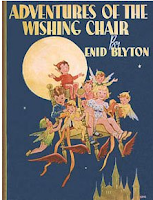
 I'm a bit embarrassed at how I forgot about Enid Blyton's books when I first tried to think of my favourite children's books; she wrote so many, after all. But when I got down to some serious thinking on my own favourites of hers, it was this one that popped up in my head first. I don't think it was as popular as The Magic Faraway Tree, which I have to say I've never read, but I think it was in the same vein. Mollie and Peter get rescued by a flying chair from an antique shop whilst shopping for their mother's birthday present, and when the chair stays with them, they discover it can fly them to Fairyland, and all other kinds of magical places! Naturally, they go on many jolly adventures, and even rescue a pixie, Chinky, who comes to live in their toy room and look after the chair for them. I've got to admit; I don't actually remember any of the places that they go on said chair, but it's the feeling that counts here; the idea that, with the right kind of transport, you can visit the most amazing places. Much like all of Blyton's books, they are a bit sickly-sweet; everyone's ever so nice to each other, and ever so remorseful when they're told they're being a bit beastly, and it's not a proper meal unless it's washed down with lashings of ginger beer - but I don't think it's the proper Blyton experience unless it's got that Wartime-Britain style patter to it. I've heard that quite a few of Blyton's series have since had 'new' titles written for them in recent years - More Wishing Chair Stories, published in 2000, is an example - but I really don't agree with this; it's just publishers trying to cash in on the nostalgic feel of Blyton's books, and you can't recreate that. Adventures Of The Wishing Chair is maybe not the best of Blyton, but it's a magical collection of tales that still, from time to time, make me hopeful that the next chair I sit in is a wishing chair. So far, no such luck.

Just So Stories, by Rudyard Kipling
 Anyone who's read this blog a few times will probably know that I am a sucker for a beautiful looking book - I'm a bit shallow like that - and this has got to be the first book I fell in love with, lookswise. The particular edition, pictured - which I have had for as long as I can remember - has the most gorgeous illustrations by Isabelle Brent, with metallic highlights, spectacular borders and a feel of magic to them; it's a joy to look at, and I remember flicking through the book to just look at the pictures more than once when I was a child. But the magic of the book is not, of course, in the pictures; it's in the stories, and O, Best Beloved, what stories they are! Written in a way that is almost lyrical, yet with a childlike feel, this collection of short stories explains the answers to such questions as How The Leopard Got His Spots, How The Alphabet Was Made and The Beginning Of The Armadillos - which, by the way, are my three all-time favourites of the Just So Stories. It's hard to explain why I love this book so much; again, I think it comes down to how it makes me feel. When I pick up the Just So Stories, I am transported to beautiful, hot, mystical countries, which are home to speaking animals, Djinns, and men of infinite-resource-and-sagacity. You can tell just from reading these books that Kipling was a man who read much, saw much and lived in exotic countries, but also had children, and had written these stories for them. For a long time I thought my love for this book was largely down to the illustrations by Isabella Brent, but a few months ago I found an edition in what might be considered a 'grown up' format, and I was so excited I snapped it up at once. Even without Brent's pictures, I still felt the same joy as I read through the stories, and this is how I know I love the Just So Stories.

Prince Caspian, by C. S. Lewis
 First of all, I'd just like to say - it was flipping difficult, trying to find an image for this entry, because thanks to Disney and Ben Barnes, all that came up on Google images for ages were stills and promo shots for the film! Anyway - this might seem like an odd choice, as surely the obvious option is The Lion, The Witch and The Wardrobe? Well maybe - if I'd read The Lion, The Witch and The Wardrobe first. As it happens, I actually read Prince Caspian first, as when I was growing up it was the only one of The Chronicles Of Narnia that we had in the house, for some reason - in fact, it wasn't until I was writing my university dissertation on Classical influences in Narnia that I even read the full series. I think what appealed to me most about this book was the fact that I didn't know what happened in The Lion, The Witch and The Wardrobe, beyond what the characters discussed - this meant that I felt more curiosity about this Golden Age of Narnia, and of Aslan, as I was not familar with their roles, or the events, of LWW. For instance, I didn't know why Edmund didn't get a present from Father Christmas, and I didn't understand the curious nature of Narnian time in relation to Greenwich Mean Time. Consequently, even though it's technically a sequel, it was an entirely new novel to me, with brand new characters to become acquainted with, new mysteries to understand and geography to become familiar with - the ruins of Cair Paravel were a particular example of this, as I managed to get a sense of nostalgia for the magnificent palace it once had been without ever knowing it as said magnificent palace. Prince Caspian not only introduced me to Narnia, but also instilled in me a fierce desire to know more about the fictional country, and it's inhabitants; it may even be partially responsible for why I was able to write my dissertation with as much enthusiasm and interest as I did. When I read Prince Caspian now, I remember how I felt those first times I read it - the nostalgia for something I didn't really know, the desire to learn more, the interest in Narnia - it reminds me why I love books; the power they have to make you want more.

Tuesday, 13 March 2012

Childhood Favourites: Literary Nostalgia

A few days ago, I was pondering what subject to write about next, when I realised my mind had wandered over to a book called Vampire Park, by Willis Hall, which I had owned as a child. I hadn't thought about this particular book in years, had forgotten about it's existence, even, until the forage in the loft at my parents' house that helped to kickstart this blog. Since then, and I'm not entirely sure why, it's stuck in my head. It's not exactly a literary classic; the story is about a 'veggie' vampire (take that, Cullens - and you thought you were the only ones!) who only drinks tomato juice, and who returns to his castle in Transylvania after a holiday to discover his distinctly un-vegetarian, British cousin Freddie has turned up, with claims to the castle and a plan to turn it into a theme park. Count Alucard is too mild-mannered to question Freddie and so lets him get on with his plans, though there's something odd about this cousin of his...

Alright, it's not the stuff of great literature - copies are currently selling for one english penny on Amazon Marketplace if you're interested, though the postage will cost more - but for some reason it's a book that sticks with me; from what I can remember, it was a bit clever, there was a decent plot, and it was funny, and when you're ten years old there's not a whole lot more you'd ask for from a book. If you asked me now what my favourite book as child was, you'd be waiting a good while for me to come up with an answer, and I'd hope it wouldn't be this, but maybe ten-year-old Jasmine would answer differently. It did, however, get me thinking hard about what my favourite book from childhood would be, and I struggled so much with the answer that I started to give myself a headache. For starters, I couldn't really think of any books from my childhood, apart from fairly obvious ones, which made me sad - so instead, I enlisted the help of Twitter and Facebook to see if anyone else remembered their childhood favourites.

They did, and I was quite surprised by what I found, for it seems that I'm not the only one who struggles to pick a favourite; a quarter of all the people who responded to my nosey question couldn't pick just one. Indeed, one friend kept coming back again and again, with contributions ranging from the little-known The Mennyms by Silvia Waugh, to Mallory Towers by Enid Blyton. What surprised me more, though, was that 42% of books mentioned were published pre-1980; for a lot of the respondents, that's before they were born. Of that 42%, a third were Enid Blyton titles, the most popular of which was The Magical Faraway Tree series, though The Naughtiest Girl In The School and The Secret Seven did get a look in (surprisingly, no Famous Five - not a lot of love for Timmy and George, then). In fact, a lot people answered with what could be considered 'classic' children's literature; The Hobbit, The Chronicles of Narnia, Heidi and Little Women to name but a few. I wasn't expecting this, if I'm honest; I suppose I had half hoped that more people would come up with slightly shameful examples, such as my dear own Vampire Park, but no, I've been put in my place. There were a few authors and titles that I was expecting, such as Roald Dahl, which I got (curiously, out of the mere four people who mentioned Dahl, only one went for a specific book - The Twits, if you were wondering - whereas the rest went for just 'Roald Dahl'), Jacqueline Wilson, who also cropped up, and J. K. Rowling, which I didn't get. That was a bit of a shocker; given that my generation grew up with Harry Potter, I was under the impression that books from the series would come up a fair few times, but no, not even once. I suppose that might be due to the fact that it was still being published when we were all in our late teens and early twenties, so to call it a childhood series to people of my age might not ring quite true. Funnily enough, Enid Blyton never even occurred to me as being an option, and yet, as mentioned before, her name came up over and over again, more than anyone else, in contributions by men and women alike.

Another surprise was the number of, dare I say it, 'baby' books that came up; The Hungry Caterpillar, Not Now, Bernard and Peace At Last! all got a mention, and, to my delight, a personal favourite of mine, Winnie the Witch. On the flipside, there were a few surprisingly 'adult' entries, of which The Secret Diary of Adrian Mole, aged 13 and 3/4 and The Lord of The Flies are two examples. I myself was a bit shocked to see The Lord of The Flies associated with childhood by a contributer, as I read it when I was about seventeen and personally would not consider it a childhood book; a teenagers', maybe, but not childhood, not by a long shot. I suppose this just goes to show that there isn't an age limit to childhood, that the term 'childhood' itself holds no boundaries, and the same applies to books from that age. If you considered yourself a child when you read a certain novel, then it was a childhood book. Maybe this is why Harry Potter didn't crop up; I was considering myself a bit of a grown-up when I first read The Philosopher's Stone, at the grand old age of twelve, and because I still own copies, and still read them, they're not children's books to me; they're a weird kind of in-between, books that are, technically, for children, but appealling to age groups far outside the ages of 'childhood'.

What I loved most about the responses that I got, was the number of people who seemed to have put thought in; one contributor offered a reason for why The Magic Faraway Tree was one of theirs ('my mum used to read them to us complete with banging saucepans when she was reading about the saucepan man'), whilst others offered a book for each of the three stages of childhood - toddler, child, young adult - which just seemed to prove to me that you can't put an age on childhood. It's definitely given me food for thought in terms of my favourite childhood books, and I'll be compiling a list soon to sit alongside this entry. In the meantime, though, if you happen to remember a book from your childhood, let me know; I've loved reading all your thoughts, and all the surprise entries - Goosebumps was one I never expected to see, but I know I read nearly all of them and I even had the board game to One Day At Horrorland - and if you have any more, I'd love to know. They might be some forgotten favourites of mine that I'll want to reclaim.

Saturday, 10 March 2012

The Holiday Collection, Part One: First Impressions

Following on from my previous post on judging books by their covers, I thought it'd be a good wheeze to take in a first impression of the books I am taking with me on me jolly 'olidays in a few weeks' time, and do a bit of a compare-and-contrast when I get back. I haven't read any of these before, although in some cases I know a bit about them, so I will be attempting to divulge the contents based entirely on the cover, the blurb and just the general feel I get from the book. So, to business!

1. THE HUNGER GAMES, BY SUZANNE COLLINS

Why I'm taking it: It is, of course, about to become a major movie franchise, in the vein of Harry Potter and Twilight, and I've decided I want to read the book before I see the film. I learnt this lesson with the first in the Twilight series; if I had read the books first, I may have realised that it is, in fact, a horribly misogynistic depiction of the deeply unhealthy infatuation a young girl has for a dead man, and death. I may have noticed earlier on that, while the relationship between Bella and Edward probably seems deeply romantic to a fifteen year old girl, it's actually a very bad example to set to young girls, especially New Moon, where Bella goes off the rails because Edward dumps her. It's a bit sick, this portrayal of 'love'. As it happens, I saw the film first, promptly got all girly over Robert Pattinson and his brooding good looks, devoured all the books in a single week and took longer than I'd care to admit to realise that they are, in fact, rubbish. I would like to avoid such a fate with The Hunger Games, and give the book a chance first.

Previous knowledge: From the trailers that I've seen for the film, it's about a big tournament in which young people compete for the entertainment of millions of people watching around the globe... But I think it's a bit more serious than The X Factor, because no one seems to want to take part in this one. I also know it combines elements of the Theseus myth, which involves the hero travelling to Crete as part of a retinue young of men and women, who are a tribute to the Cretan king, Minos, who will then feed said tribute to his pet, the Minotaur. It seems to be like an Olympic Games where you don't want to be in it, because if you lose, you get eaten... Or something.
 
What the cover says: Well it... it doesn't give much away, does it? I'm assuming that  the gold symbol is that of The Hunger Games, much like the big red X of The X Factor. I can't work out what kind of bird that is, though I am reminded of the myth of Procne, Tereus and Philomela, all of whom were turned into birds... but that's probably just because I've got myths on the brain. The arrow though, that's got to mean something, as I know from an exerpt from the film that Katniss - the heroine of the novels - is a pretty nifty archer. Aside from that though, it's anyone's guess. It's quite a sophisticated cover though - you wouldn't need to publish adult-covers for this one, as with the Harry Potter books.

What the blurb says: 'Winning makes you famous. Losing means certain death.' Blimey, that's a bit harsh! I'm already hooked though. The rest of the blurb gives very little away - as expected, The Hunger Games is a television show in which 'there is only one rule: kill or be killed.' Katniss is also appearing to be a bit of a bad-ass; I suspect in a Twilight/Hunger Games fight, she'd take Bella out in seconds. 

How I am feeling about it: Quite excited. The movie hype is starting to get to me, and I'm really glad I won't get a chance to see the film before I go away. Before I go, I may even buy the other books to take with me, because I suspect I will be wanting to read them as soon as I finish this one. I also love a good series of books - I am only full of admiration for authors who are able to write not one, but several, books about the same characters, and have come up with plots for each book, whilst also tying the whole series together. I even include Stephenie Meyer in this, whom I disagree with strongly over what exactly 'true love' is.

How much am I looking forward to it: On a scale of one to ten.... 9

Order of Reading?:  Second. I'd like this to be one I read only on holiday,  and not on the plane or anything, as I want my reading of it to be as uninterrupted as possible - no tannoy announcements, no air hostess offering me a beverage, nothing. I want to give this one my full attention.


2. THE MAP, BY T.S. LEARNER

Why I'm taking it: I always have to take a fat book with me on holiday, because it's pretty much the only one I can guarantee that I won't finish in a day (I once read three books in one day on holiday one year... true story), and this is the fat book. It's also slotting pretty nicely into the 'Da Vinci' mould, and I do like one of those on holiday. You know the ones I mean: The Da Vinci Code by Dan Brown, Angelology by Danielle Trussoni, The Righteous Men by Sam Bourne... These are all psuedo-historical thrillers, involving some far-fetched plot, a few bizarre references to real texts or paintings, and a wildly speculative outlook on some unproved theory or myth. They're excellent fun to read, require hardly any extra thought, are easy to pick up and just as easy to put down, and invariably overlong, so perfect for lolling by the pool or on the beach.

Previous knowledge: None. I pretty much picked it up because I saw it and thought, 'Ooh, that's a good-looking book, and it's fat too.'

What the cover says: It's all old-looking and parchmenty, so I guess that must be representative of the titular Map. It's also got a tagline, 'Decipher the clues, Discover the truth', so I'm bang on track with comparing it to The Da Vinci Code and suchlike. I can't even guess, however, what that symbol in the middle of the page is - I'm reminded of the Vitruvian Man, bizarrely, and a helix, so to be blunt about it, I've no idea what's going on. 

What the blurb says: Yep, this is seeming more like another Da Vinci Code with every glimpse. Typically, there's a few portentous statements such as 'A band of black magic worshippers has gathered... An ancient mystery is calling...' The main character is, it seems, a man called August Winthrop, who's name I quite like, who is guarding a map that leads to labyrinths, and as usual, he has to keep it out of the bad guys' hands. Sounds fun. Oh look, and the last section says a bit about Dan Brown - 'a sophisticated, relentlessly exciting thriller in the tradition of Dan Brown, Robert Harris and Kate Mosse.' Well, I like the use of the word 'sophisticated' as it implies it's as clever as it's predecessors, but 'relentlessly exciting' sounds a bit desperate. 

How I am feeling about it: It's hard to tell, as I am looking forward to it, but I'm not currently desperate to read it.

How much am I looking forward to it: On a scale of one to ten.... 7

Order of Reading?: Most likely to be third. This will be because, if I stick with the current reading order, I'll probably steam through the first two by the mid-week point of my holiday, panic, and grab this one to try and delay finishing all my books before the holiday ends (although it always happens, and I always have to get started on my boyfriend's books).


3. THE WELL OF LOST PLOTS, BY JASPER FFORDE

Why I'm taking it: I've read the first two of the Thursday Next series, which is set in an alternate universe where literature is held in extremely high esteem, one can 'read' themselves into a book (literally, and physically) and dodos have been re-created, so it seemed a logical progession to move to number three. I enjoyed the first two immensely - although I did enjoy the first novel, The Eyre Affair, more than the second, Lost In A Good Book, so if this is a sliding scale then maybe I shouldn't get too excited. However, I am considering this my 'safe' read, the one I am almost guaranteed to enjoy, so fingers crossed it'll pull through.

Previous knowledge: Well, without giving too much away about the previous two novels, I know that Thursday is currently trying to get her husband back, whilst attempting to avoid both an evil corporation that's after her and the consequences of changing the ending of Jane Eyre. I also know that it's a quirky, fun, referential series that focuses on all things bookish and bring characters from other books out into the world - imagine the Cheshire Cat as a librarian, for example, or Miss Havisham as a petrolhead - so I'm expecting some laughs at the funny bits and some snobby smirks at the literary bits.

What the cover says: Not a great deal, actually. The previous two books in the series both feature cars streaking through an unusual landscape for a car to be in, so this is just in keeping with the theme, I guess. The first book's car cover was related to the story (in a way) but the second one wasn't, so whilst I'd hazard a guess and say that I think the person in the car may be the aforementioned petrolhead, Miss Havisham, beyond that - and the fact she's driving through a library - I've got no idea what's going on. It looks fun, though.

What the blurb says: The Well Of Lost Plots actually crops up in Lost In A Good Book; we are told it is the place where all literary ideas are, even the ghosts of vague background characters (like Terry Boot in the Harry Potter series, for example). The blurb reminds the reader of what happened in the previous book, and why our heroine, Thursday, is now living in 'an unpublished novel of dubious merit entitled Caversham Heights'. We're also told that there's some killing going on in this one, so I'm a bit nervous as it sounds like a few characters are going to get the chop. It's shaping up to be like it's predecessors though, which can only be a good thing, considering how enjoyable they were.

How I am feeling about it: Pretty good - I'm feeling like it's meeting up with a new friend that I'm getting to know, so I'm looking forward to it.

How much am I looking forward to it: On a scale of one to ten.... 8.

Order of Reading?: First, probably - don't want to ruin continuity by having too many books between this and the previous!


4. 1984, BY GEORGE ORWELL

Why I'm taking it: It's a book I've never read (obviously), but always thought I should... And seeing as I plan to have a verrrry lazy holiday, it seems as good a chance as any to read a book I've never really found the time to read.

Previous knowledge: Barely any. I cannot stress this enough - not only have I never read this book, but I genuinely have no idea what this is about. I mean, I know that it's set in what was Orwell's future, in a dystopian world where everyone was governed by an all-seeing authority. I also know this is where Big Brother comes from, a concept which I naturally find uncomfortable, and a programme which I found equally unsettling. I think it's also where Room 101 comes from, but funnily enough I'm not expecting it to be an amusing talkshow with Paul Merton. Also, having read Animal Farm, and being aware of what a disturbing novel that was, I'm expecting something else unsettling. That is pretty much all I know about it.
 
What the cover says: It's a creepy-looking edition, isn't it? All those eyes, all over the place... they're obviously representing Big Brother always watching, and I can see some propaganda-type writing scrawled faintly over the eyes; I can make out, 'Ignorance is Strength', which is ominous, and the words 'War' and 'Freedom' but that's it, so there's some politics in here somewhere. I'm pretty sure the red symbol must mean something too but I can't work it out, so that's something I'll look out for in the book. Finally, I can see something furry in the corner, by 'George', which could be a rat but is too faint for me to be sure. Rats are associated with dank, dirty places, and can squeeze through tight holes and get pretty much anywhere; they're also evil, as anyone who's seen Lady and The Tramp will tell you. So far, this is looking like an intriguing, but terrifying, read.

What the blurb says: Well, it's told me that a man called Winston, who works at the (evidently ironically named) Ministry of Truth, is re-writing history to 'suit the needs of the Party'; so there is some politics then. Apparently he doesn't like this job much as he is 'inwardly' rebelling - what does that mean? Assumedly he can't outwardly rebel due to Big Brother always watching. Winston, it appears, also falls in love, which seems to be the point at which the novel truly begins. Already I'm asking questions to myself - 'is love banned in this world? What is being rewritten in history by Winston? Why did Orwell fear for such a world?'. I think it'll make for an interesting read, though not an enjoyable one.

How I am feeling about it: Kind of resigned, actually. I'm reading it because it's an opportunity to read it, and because I feel I should, not necessarily because I want to. I'm not really a fan of 'futuristic' novels and this is one of the best-known ones out there.

How much am I looking forward to it: On a scale of one to ten.... 4

Order of Reading?:  I'm going to say fourth, because I know I'm not looking hugely forward to reading it, but I may have a change of heart and try to get it out of the way early on.


5. THE GRAPES OF WRATH, BY JOHN STEINBECK

Why I'm taking it: I'm not, actually; my boyfriend is currently reading it, and since I'll probably run out of my books, I'll be reading this when he's finished.

Previous knowledge: Not a whole lot; I do know it's an American classic, focusing on a family travelling across America to try start to afresh in California, during the Great Depression, and like 1984, it's a book I feel I should read, but that's pretty much the extent of it.

What the cover says: A surprising amount, actually; there's the outline of an eagle, America's representative creature, and a long, stretching road through a somewhat desolate-looking landscape that disappears into the horizon. It's already a transparently American novel, involving a road trip of sorts - something that America does better than anyone. I'm getting a feeling of both possibility and fear from the landscape, and I'm also finding it a bit intimidating.

What the blurb says: Well, it covers the journey to California element, and the reason why they're leaving, but also hints at disappointment, arguments and  'uncertainty about what awaits their arrival...' Frighteningly, though, there is a little afterword from the author himself : 'I've done my damndest to rip a reader's nerves to rags, I don't want him satisfied.' This does not sound like a relaxing read, but unlike with 1984, for some reason this piques my interest.

How I'm feeling about it: Intimidated; it sounds a bit heavy going, and like I'm going to be confronted with issues I've never encountered before. My knowledge of American history is pitiful, so I think I'm going to learn a lot, and not all of it I'll want to know. I am looking forward to it, strangely.

How much I am looking forward to it: On a scale of one to ten.... 7

Order of reading?: Fifth, seeing as I'll have to wait for the boyfriend to finish it first.